
The Opera Model
Applied systems thinking — because great organisations perform like an orchestra.
The Opera Model is a systems thinking framework that helps organisations to better understand their operational dysfunction, to make it diagnosable and fixable, before rushing into buying yet another tool.
Everything feels like a giant blob
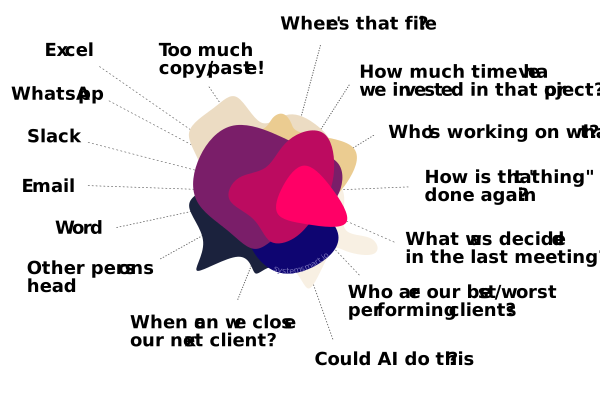
These questions come up every day. And every day, the answers live somewhere else — in Excel, Word, Slack, Email, WhatsApp, or someone’s head. The tools are there. The effort is there. But the pieces don’t connect.
This is what most growing organisations look like from the inside: a shapeless overlap of tools, questions and good intentions with no structure holding it together. Not because people aren’t trying — but because the organisation has outgrown its own MO (mode of operation).
This is a system maturity problem. What got you here won’t get you to the next level.
Most organisations suffer from operational dissonance — but mistake it for a tool problem.
The easiest fix is to reach for another tool. A new project management app. A better wiki. An AI assistant. But adding instruments to an orchestra that can’t hear each other doesn’t improve the sound. It adds noise.
Nevertheless, you sense that something in your organisation sounds off (or it feels like pure chaos behind the scene).
The better question than “Which tool?”
The Opera Model is the way out of duct-taped tech. Before adding a tool, let’s understand what’s really going on. Every organisation runs on four operational dimensions:
- How things are done
- Who does what and when
- How a team stays aligned in daily operations
- Where the organisation is heading strategically
When these four fall out of tune, you get operational dissonance — and duct-taped tools are usually the first symptom.
The Opera Model helps you find the cause(s). Trying to fix things too early by asking “which tool do we need?” will only cement the current situation of duct-taped tech. The better question is “Which of these dimensions is broken?” From there, we can develop an understanding of how well the four are working together.
The orchestra analogy
The idea came to me in 2021 while restructuring a Notion workspace that had grown completely out of control. I needed a way to explain what was missing — and why just adding more documentation wasn’t the answer.
I first wrote about it in German in 2023 as „Die drei Arten von Wissen” and refined it through years of building systems for clients.
The word “opera” comes from the Latin opus, meaning “the work”. From this root, the English language inherited a whole family of words: operate, operations, operator. When we talk about business operations, we are — without knowing it — already talking about opus.
An opus is not just work. It is a body of work — something built over time, that outlasts any single performance.
That is exactly what a well-structured organisation should be: a well-attuned system orchestrated by aligned people, especially true in the age of AI.
What makes a great opera: The Four Dimensions
To create a sound opus, meaning operations, four dimensions need to play in harmony. Each needs to understand their role and limits to stay in sync.
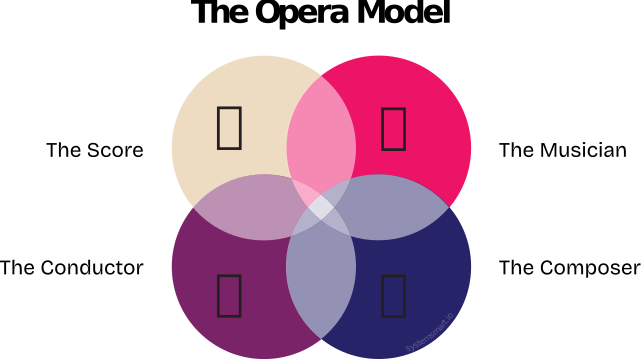
🎼 The Score – knowing how to play
The Score represents all the knowledge of how things are done in an organisation. It is the most static of the four dimensions — it changes seldom, and when it does, it is deliberate.
SOPs, wikis, how-to guides, checklists, templates, onboarding documentation — these all belong to the Score.
It is what keeps the organisation from starting from scratch every time.
🎻 The Musician – knowing who plays and when
The Musician represents all the knowledge of execution — who does what, and when. This is the most dynamic of the four dimensions, changing constantly as projects evolve, priorities shift and deadlines move.
Project management, task ownership, deadlines and recurring todos all belong here.
It is the dimension where things are getting done — you can hear and see the music play.
🪄 The Conductor – keeping everyone in sync
The Conductor represents operational alignment — the rules, rhythms and communication patterns that keep a team in sync day to day. This includes all employees, team leaders and management.
It is the most fluid of the four dimensions, operating almost daily through meetings, messages, check-ins and feedback loops.
The Conductor defines the rules of engagement: which channels are used for what, how decisions are documented, how meetings are run and followed up. Emails and Slack are used for nudges and quick exchanges — not multi-topic threads where topics are mixed, decisions are buried, or detailed work instructions are given.
Think of the conductor as a rhythm-giver, ensuring everyone is in harmony, without branching out into telling musicians how to play or what to play.
🎭 The Composer – planning the concert season
The Composer represents strategic alignment — the vision, direction and creative ambition of the organisation. This dimension belongs to Management.
The Composer plans the concert season: which pieces will be played, for which audience, and with what artistic intention. Translated into business: vision, goals, strategic initiatives and the OKRs that measure whether the organisation is moving in the right direction.
The Composer also defines the “sound” and “experience” of the organisation — its brand, culture and creative direction. Without a Composer, the orchestra plays — but nobody knows why, or for whom.
In the early days of a company, The Composer is of low importance. But the more clients are served and more musicians are hired, the more The Composer is needed to give the enterprise direction.
Out of Tune Dimensions
The Score – when the organisation freezes
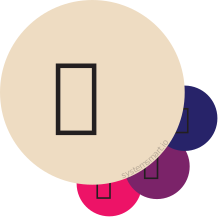
When the Score dominates, the organisation becomes obsessed with documentation, standards and rules. Every process needs a procedure. Every decision needs a protocol.
Think of the overregulated administration that gets done nothing. The result is a work environment where people are afraid to act — because there are too many “shoulds”.
There are too many contradicting procedures, new hires need a PhD just to dissect the instructions and weed through outdated material.
The Musician – when musicians play their own notes
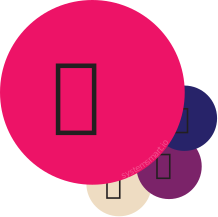
When the Musician dominates, the organisation is in a permanent state of doing. Here an extra thing and there an extra loop.
Tasks multiply. Projects pile up. Everyone is busy — genuinely busy — but they can’t see the forest for the trees.
The team races through inboxes full of tasks without stopping to ask whether they are playing the right piece. The team is overworked, deadlines are missed because they got buried, or the same work gets done twice because tasks were scattered across inboxes, spreadsheets, and heads. And then priorities and deadlines shift constantly, resulting in a daily Rubik’s Cube game for everyone.
In this state, the organisation confuses busyness with progress and more for better — and wonders why the team is exhausted by Wednesday.
The Conductor – the orchestra rehearses forever
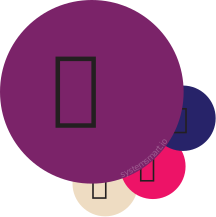
When the Conductor dominates, the organisation lives in a permanent state of coordination. Meetings about meetings. Threads that touch 10 topics. Decisions that circle back endlessly because no one has the authority — or the courage — to close them.
Everyone is aligned in theory. Nothing moves in practice.
People are stuck in meetings, coordinating Slack, WhatsApp, inboxes, and informal water cooler conversations. So much energy goes into coordination that there is little left for doing the actual work, or it gets pushed into evenings and weekends.
The Composer – the orchestra plays beautifully, but in an empty hall
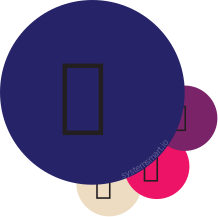
When the Composer dimension is absent, the organisation executes well but without direction. The Score is in place. The Musician is active. The Conductor keeps things running. But nobody has asked:
- Why are we playing this piece? What do we want to achieve?
- When should we play what? For whom?
- Are we playing for the right people?
- Where do we want to be at the end of the season?
The symptoms are subtle at first. Good work gets done, but it doesn’t compound because it isn’t measured and aligned with the company’s direction.
Without a Composer, an organisation is driven by individual initiatives, personal interpretation of leeway, or whoever’s the loudest gets served first.
Note: The Composer is the last dimension to activate. When operational chaos is high — when the Score is missing, the Musician is overloaded, or the Conductor is overwhelmed — it is nearly impossible to think strategically, so fix the floor first, then compose the season; the same sequence applies when you consider implementing AI in your business, because AI is a multiplier, and you want a strong basis to multiply from.
How to get started with The Opera Model
The first step is not to build anything. It is to diagnose to save time and money.
The Opera Model helps you identify where things are out of tune. With the following questions, you can better assess the state of each dimension.
🎼 The Score
- Do you document how things are done?
- Can anyone find that documentation without asking?
- Is it up to date, and does it reflect reality?
🎻 The Musician
- How visible is the work across your team?
- Does everyone know who is responsible for what — and by when?
- Can people manage their own workload, including blocked time for meetings and recurring responsibilities?
🪄 The Conductor
- How often does your team sit through something that could have been an email?
- Do you have a structured meeting agenda — and does the team follow through on it?
- Are meeting notes transcribed, action items captured, and connected back to the relevant projects, clients and tasks?
- Do you have guidelines in place for which communication channels are used, and how?
🎭 The Composer
- Does your organisation have a clear vision and strategic goals that everyone knows?
- Are those goals broken down into concrete initiatives with owners and timelines?
- Do you measure progress — and do those metrics actually reflect what matters?
- Does your organisation play great operas? Is your brand, company culture, and vision felt by your employees?
The next step: A deeper self-assessment
Turn your rough self-diagnosis into a sharper and company-wide assessment.
From Diagnosing to Fixing: Building the System
We use The Opera Model in our consulting work because it helps our clients articulate their pain points and ensures we address all aspects of a business organisation without becoming too tech-abstract.
The Opera Model helps to understand what’s working and where things out of rhythm. Because we diagnose before we pull out the scalpel from the drawer.
Once we understand that, we can translate it into a blueprint that tells us what to build, how to train your team and keep the system in tune as things grow and scale.
Without analysing your current operations, there’s a risk that system design becomes random or focuses on the wrong dimension — just because it screamed the “loudest”.
With The Opera Model, every dimension is considered to create a great performance and The System Transformation is how we make it happen.
When to implement AI
When we help organisations transform with our The System Transformation, we build for an AI-centric organisation from the start.
How we diagnose, build, implement and train your organisation depends on what we’ve identified in the beginning.
Generally speaking, your organisation needs to have a “sound” foundation of aligned people, clear processes, the right tools, and centralised data to propel your company forward with AI.
The Opera Model: Our sound approach to understanding your operations
The Opera Model is a tuning fork. It tells you where the sound is off so everyone can get back in rhythm.
Most operational dysfunction does not come from lack of motivation or intention. It comes from an invisible imbalance between the four dimensions that every organisation needs.
Now you have a name for it:
The Score. The Musician. The Conductor. The Composer. Keep all four in balance — and your organisation starts performing and filling concert halls.
FAQ
Is The Opera Model only for teams or also for solopreneurs?
It is for everyone. Solopreneurs wear all four hats simultaneously.
That is precisely why the model is so useful for them: it helps identify which hat is being neglected. Most solopreneurs over-invest in execution (Musician) and under-invest in structure (Score), find it hard to coordinate efforts (Conductor) and lose long-term perspective (Composer).
The model gives them a language to diagnose that imbalance, so problem solving isn’t soley driven by buying another tool.
Which tool should I use to implement The Opera Model?
The model is tool-neutral. If you diagnose your organsiation with the help of our model, you might want to use visualisation tools such as Whimsical or Miro.
That said when it comes to building the system, we often build with Notion — because it is one of the few tools flexible enough to house all four dimensions in a single workspace. It’s not fun if musicians have to switch concert halls constantly.
Where do I start if all four dimensions are out of balance?
It depends on where your organisation is right now. If you want to replace existing structures gradually and build a solid foundation, start with the Score — get your documentation and processes in order. If you need to optimise on the go, start with the Musician — make work visible, clarify ownership and clean up execution.
The Conductor is almost always secondary: in our experience, an overdeveloped Conductor is usually a symptom of an underdeveloped Score or Musician. Fix those two first, and the need for excessive coordination drops on its own.
Once the three are aligned, build the structures for long-term strategic alignmen (The Composer).