About the system nerd Natascha Buck
Meet Natascha

Main driver: Curiosity
- Questioning things (myself included)
- Getting to the bottom of things
- Making things work
I can
- read a recipe and smell it in my head
- think visually and three dimensional
- teach myself anything (if I want to)
I am
- a polymath at heart
- 🩷 love pink and stripes in b/w
- my home is styled in dark shades
- probably neurodiverse
My motto: Make systems sweat more than your team.
I’m the personal trainer for teams who want a connected system and are willing to put in the sweat to get there.
The TLDR of 30+ years work experience
These are the boxes I’ve ticked over the years.
Business models
- Startup
- SME
- Corporate
Industries
- Professional services
- Finance
- Governement
- Craft business
- Food production
Corporate areas
- Operations
- Marketing
- Sales
- Project management
- Business analysis
The TLDR that shaped the person
Grew up speaking 4 languages (German, English, French, Arabic) in North-Africa.
But not Swiss-German (a Alemannic dialect with its own pronunciation, grammar and vocabulary) because my parents felt that it would be a “bit much” to add a 5th language to the mix. We started to talk Swiss-German once we moved back to Switzerland.
I have a Russian first name, but Swiss-Austrian roots — my mom just liked the name.
Today, I’m fluent in Swiss-German, German, English and Spanish. Forgot almost all of my Arabic and can order a croissant in french 🥐
The longer (entertaining) version
My first organisational project
At the age of 4 I seem to have been a organisational nerd already, sorting clothespins by color per line of the drying rack.
The oddness of repeating inefficient processes
I have a low threshold for boring things, so it always eludes my logic to accept broken processes or high-effort repetitive work. It always feels like trying to fit a square peg into a round hole and repeating it over and over.
The effort in trying to make it work could as well be put into trying to find a better way of getting it done.
That’s why I organised the messy material storage in my first days of my apprenticeship, instead of waiting for them to find the right way to onboard me. In week 4 I was made responsible for managing it and ordering supplies. The alternative would have been sitting around and do nothing. I chose being useful and learn about materials on my own.
My innate allergy to do things complicated also led me to whip up a simple system with FileMaker so that we could capture client data and categorise who would get a Christmas card and who got which type of Christmas present. Yes, it could have been done in an Excel sheet as well. But then you would replicate the sheet the next year and may have outdated address data.
A fine system to finance Christmas parties
From this simple setup I taught myself to program FileMaker from a 4‑inch (10 cm) thick handbook, so that we could track phone number orders for clients (insurances, banks), print out formated order forms to fax them and print out status reports for internal use. Before that we would manually update reports and have a separate process for ordering, meaning the report was always incomplete.
From there I expanded the system to an expense and cash pay out tracking system. With it I initiated (with the blessing of my boss) a fine system. The problem was that employees would demand their expenses but not submit their work reports (every 2 weeks). This meant longer cash flow cycles for the business, pre-financing salaries and expenses until we could invoice clients based on the reports.
The fines would go into a community pot from which we financed the yearly employee Christmas party. Self-evidently, I kept a simple bookkeeping system so that employees could track who “financed their Christmas party”.
Would this work today? Probably not. Although a clever system, it conflicts employment law.
A database, not a spreadsheet
I had a great boss who hired me to work as an assistant at the New Market team at the Swiss Stock Exchange, responsible for attracting companies going public for this new market segment (beside blue chip segment).
But the frustration about their Excel spreadsheet, where they tracked contacts, meetings, materials sent in ONE sheet, was increasing by the week. In month one I summarised the solution to “you need a database for that” and no one was (surprisingly) enthusiastic about this idea.
None of the existing systems at the stock exchange fit either. So I programmed a system at home during nights and weekends — partly to learn how the finance industry actually works, partly because I couldn’t leave the problem alone.
Then one day the frustration boiled over again in a team meeting… I casually mentioned that I had programmed something at home, that it worked and I could demo it.
The eyes of my boss widened in surprise. He saw the demo and decided on the spot that he wants it and that our team in Geneva should also use it.
The unexpected promotion
We rolled out the solution to Zurich and Geneva. Soon after, the IT police came knocking 😅 — they had “heard” someone built something without them knowing. After the demo they wanted to know how long it took. I estimated about 2 weeks. They sort of lost it. They couldn’t believe how fast I was.
I never got a financial recognition for that work, but I get to tell you this priceless story instead 😏
IT was about to introduce a company-wide CRM and asked me to join the pre-steering committee. Most members represented the business side but were not technical and often not the ones using the systems.
One day the committee discussed how data should be organised. It got too abstract and people were making many assumptions. I took the floor and gave examples — from my prior data entries I could quote names of blue chips, their CEOs, CFOs and investor relations contacts by heart and argued the future data model should regard this reality.
The room went quiet.
I shaped the data model for the new CRM, interviewed other business entities so that we could reflect their data and process needs and became the testing nightmare for the programmers 😏
From there I started, unprompted, to write documentation. Then compliance asked me to train them. Then new hires. I ended up travelling between London and Zurich as the go-to person for the system.
I got a new boss and he promoted me to become the Swiss Stock Exchange’s first CRM Analyst.
What’s not apparent of this success story is, that I did all this extra work beside my regular job as assistant of the team. But I liked the “extra” more than the job profile I was originally hired for.
The pattern repeated itself: I got hired for a job role and did “more”. In hindsight the “more” was always a true calling, it took some time for me to realise it and I continued to find other creative outlets.
Creativity was calling
I worked in private equity, ran the fund reporting project and organised the general assembly for our international investors. Beside my regular duties, I built an investor tracking system with FileMaker so that the company could see which investor was invested in which product — and print out tailored history reports that prepared them for their fundraising tours.
But the creative side in me was undernourished. I discovered cake making, taught myself baking and decorating skills, and eventually turned it into a small business — Fleur de Sucre.
That meant teaching myself to build webpages, taking great photos and coming up with a cake menu. Then people found me googling and wanted cakes made. Suddenly I needed processes for client negotiations, design finding, cake tastings at home, and delivering wedding cakes on time.
Quoting and production planning took too much time — I was still working a regular job and produced everything evenings and weekends. So naturally, I built a pricing system that could calculate the price per square cm based on ingredients, size and labor. Then a production planning system in FileMaker, where one click printed out tailored recipes per tier. Hang them up in the kitchen and get baking.
I even won a cake prize for my designs.
But the food business is only financially viable at scale — limit your product options, repeat production with cheap labor. My business was the opposite: custom made, one-of-a-kind, and therefore too expensive to be profitable. This model only works as a professional hobby.
While this insight was slowly dawning on me, I noticed that I liked being heads down in building the production system more than being hands deep in cake batter and shaping sugar roses.
The identity shift
After realising that my business model isn’t sustainable, taking up too much space at my home (the entire production was ran from my home kitchen) and that I spent more time finetuning my production system and webpage — I stopped it.
Hardcore style tossed everything into the curb. Packed my car to the brim with cake stuff and drove to the dump site.
I didn’t know what to do next, but cake it wasn’t. I concluded that I would figure it out as well.
Instead I attended different communities of like-minded people.
Then one day I attended a community meeting where someone demonstrated how they run their service business with Notion.
Bam 💥 Notion
Seeing a demonstration how to use Notion for a service business, I immediately clicked with Notion. I could immediately draw from my prior tool knowledge from FileMaker.
I started to learn everything about Notion and helped others out in a Facebook community.
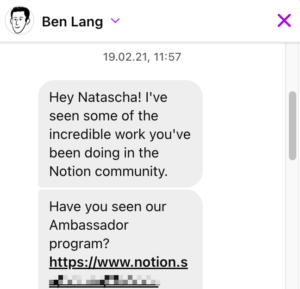
Then one day Notion’s community manager reached out and asked me if I wanted to become a Notion Ambassador.
Within a few month I became Switzerland’s first Notion Ambassador and first German-speaking Notion Certified Consultant in 2021. The 24th internationally — of today’s 130+.
Becoming me
I really like Notion. But somewhere along the way I realised that my job isn’t about Notion — it’s about what happens before and around the tool.
Every company I’ve worked with has the same underlying challenge: people need systems to run their work, systems need to reflect actual business processes, and people need the awareness to describe those processes in the first place.
The tool comes 3rd. It always has. Even at the Swiss Stock Exchange, the real work was understanding how people actually operated — the programming came after.
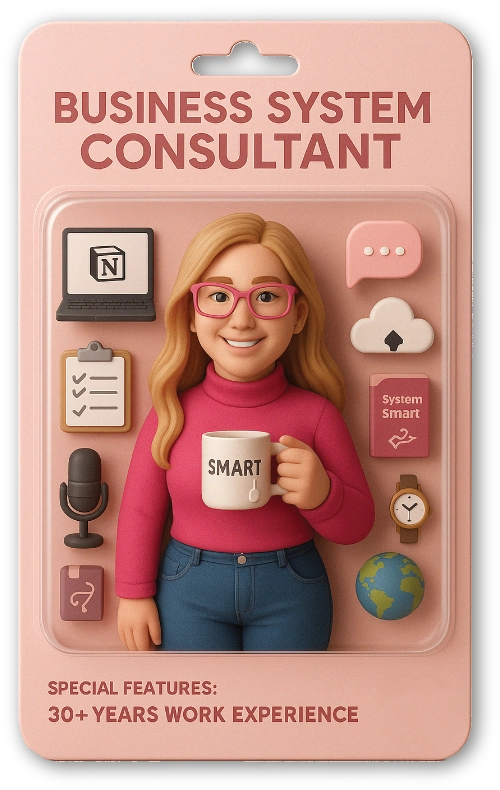
Today I run System Smart, a business system consultancy based in Zurich. I’m a Business System Consultant — and looking back, I always was. It just took a few detours through clothespins, learning to program, creating a cake business and discovering Notion to get here.
And then came AI
AI is a powerful new class of tool. But it’s a multiplier — it amplifies whatever baseline it sits on. Feed it a mess, you get a faster mess. Feed it a clear operating system with well-defined processes, and it becomes genuinely useful.
If your systems haven’t kept up with your team, you’re probably feeling the friction — information scattered across tools, processes that live in people’s heads, and new hires who take months to get up to speed. That’s the baseline I’m talking about.
I map what’s actually happening, design the system architecture, and build it with your team in Notion — not as a one-off setup, but as a 6‑month transformation that the team actually owns afterward. The system becomes the foundation. AI becomes the accelerator.